EV charging · AC chargers · DC fast chargers · Buying guide
AC vs DC EV Chargers: How to Choose for Homes, Offices, Fleets and Highways
By Raivens Editorial Team · · Updated · 6 min read
Key takeaways
- AC chargers rely on the car's onboard charger, so most deliver 3.3 to 22 kW and suit vehicles that stay parked for hours.
- DC fast chargers convert power inside the unit and deliver 30 kW or more, which suits fleets, highways and quick turnarounds.
- Choose by dwell time, daily energy need and site supply capacity, not by the highest power rating on offer.
- Load management lets several AC chargers share a limited supply without an immediate grid upgrade.
- Most commercial sites end up with a mix: AC for long stays and a few DC units where time matters.
The choice between AC vs DC EV chargers comes down to how long vehicles stay parked and how much power your site can supply. An AC charger feeds alternating current to the car’s onboard charger, which limits power to about 3.3 to 22 kW, so it suits homes, offices and anywhere cars park for hours. A DC fast charger converts power inside the unit and charges the battery directly at 30 kW or more, which suits fleets, highways and any stop where time matters.
How AC and DC charging work
Every EV battery stores direct current (DC), while the grid delivers alternating current (AC). The two charger types differ in where that conversion happens.
AC charging: the car does the conversion
An AC charger, often called a wallbox, is a smart, protected switch. It confirms that the car is safely connected, tells the car how much current it may draw and then passes grid power through. The onboard charger inside the vehicle converts that power to DC. The onboard charger also sets the ceiling: many cars accept 7.4 or 11 kW on AC, a few accept 22 kW, and some compact models accept only about 3.3 kW.
DC charging: the charger does the conversion
A DC fast charger contains the conversion stage itself, in the form of power modules that turn grid AC into high-current DC. It talks to the car’s battery management system, which requests the voltage and current the battery can take at each moment. Power peaks when the battery is low and tapers as it fills, which is why fast-charging times are usually quoted from 20 to 80 percent.
AC vs DC EV chargers compared
| Factor | AC chargers | DC fast chargers |
|---|---|---|
| Typical power | 3.3 to 7.4 kW single-phase; 11 or 22 kW three-phase | 30 to 120 kW and higher |
| Where conversion happens | In the car’s onboard charger | Inside the charger |
| Indicative time, 20 to 80% of a 60 kWh battery | About 2 to 12 hours | About 20 to 90 minutes |
| Main cost drivers | Charger unit, cable run, protection devices, smart features | Power modules, cooling, grid connection, civil works, demand charges |
| Site needs | Existing single- or three-phase supply, wall or pedestal space | Three-phase supply sized to the charger, often a new connection or transformer, a plinth and a cable trench |
| Typical locations | Homes, offices, hotels, overnight depots | Highways, fleet hubs, taxi and bus depots, retail sites |
For a closer look at charge time, the table below shows roughly how long each power level takes to deliver about 36 kWh, the energy needed to take a 60 kWh battery from 20 to 80 percent.
| Charger | Indicative time | Notes |
|---|---|---|
| AC 3.3 kW | 11 to 12 hours | Overnight top-ups |
| AC 7.4 kW | 5 to 6 hours | Common home and workplace rating |
| AC 11 kW | 3.5 to 4 hours | Car must accept 11 kW on AC |
| AC 22 kW | About 2 hours | Only cars with a 22 kW onboard charger |
| DC 30 kW | 70 to 90 minutes | City and depot fast charging |
| DC 60 kW | 40 to 50 minutes | Fleets and urban hubs |
| DC 120 kW | 20 to 35 minutes | Depends on the car’s maximum DC rate |
These figures are indicative. Real sessions vary with battery size, temperature, charging losses and the limits of each vehicle.
How to choose by site
Homes
Cars at home usually park overnight, so speed is rarely the constraint. A 7.4 kW single-phase AC wallbox replaces the energy of a typical daily commute in one to two hours, and 11 kW makes sense where three-phase supply exists and the car can use it. Look for scheduling, so charging runs during off-peak tariff hours, and choose between a tethered cable and a socket. A DC charger at home is rarely practical because of its supply needs.
Offices and workplaces
Staff cars park for most of the working day, so 7.4 kW AC points cover nearly every need. The challenge is scale: twenty chargers running at full power add up to about 150 kW, more than many buildings can spare. Load management shares the available supply across chargers and slows charging when the building is busy. RFID cards or an app control who can charge and help allocate energy costs. One DC unit can serve pool cars or visitors who need a quick top-up.
Fleets
Plan around the duty cycle of each vehicle group:
- Overnight depot return: AC at 7.4 to 22 kW per bay, scheduled to finish before the morning shift.
- Multi-shift taxis and vans: DC at 30 to 60 kW for turnarounds between shifts.
- Buses, trucks and high-mileage vehicles: 120 kW and above, matched to battery size.
Fleet operators also need per-vehicle energy reports and remote monitoring, so faults surface before a shift starts.
Highways and public hubs
Drivers stop for 15 to 45 minutes, so DC at 60 to 120 kW is the norm. Dual connectors let one charger serve two vehicles, a touchscreen guides first-time users, and QR, app or RFID authentication handles access and payment. Remote monitoring matters most here, because an offline charger strands drivers. AC points still fit hotels and restaurants along the route, where people stay longer.
What drives cost and site work
AC projects are usually limited by the building’s spare capacity and the cable run from the distribution panel. DC projects are limited by the grid connection. On a 400 V three-phase supply, each 10 kW of charger capacity draws roughly 15 A per phase, so a 60 kW unit needs about 90 A per phase and a 120 kW unit about 180 A. Many DC sites need a new connection or transformer, plus civil works such as a plinth, cable trench, bollards and a canopy. Where utilities bill for peak demand, a few fast sessions can raise the monthly bill, so load management and tariff planning matter. Have a licensed electrician confirm protection and cable sizing against your local electrical code.
Connector standards also vary by region, so confirm which AC and DC connectors your vehicles use before you order.
Checklist before you buy
- Vehicles: connector types and the onboard charger rating of each model
- Dwell time: how long vehicles stay parked at each location
- Daily energy: distance driven per day multiplied by energy use per kilometer
- Supply: spare capacity at the main panel or transformer, and whether an upgrade is needed
- Load management: whether chargers must share capacity
- Access and billing: RFID, app, QR payment or free use
- Connectivity: Wi-Fi, 4G or Ethernet at each charger location
- Mounting: wall or pedestal, weather exposure and cable management
- Support: remote monitoring, spares, maintenance, and compliance documentation per model
Where Raivens fits
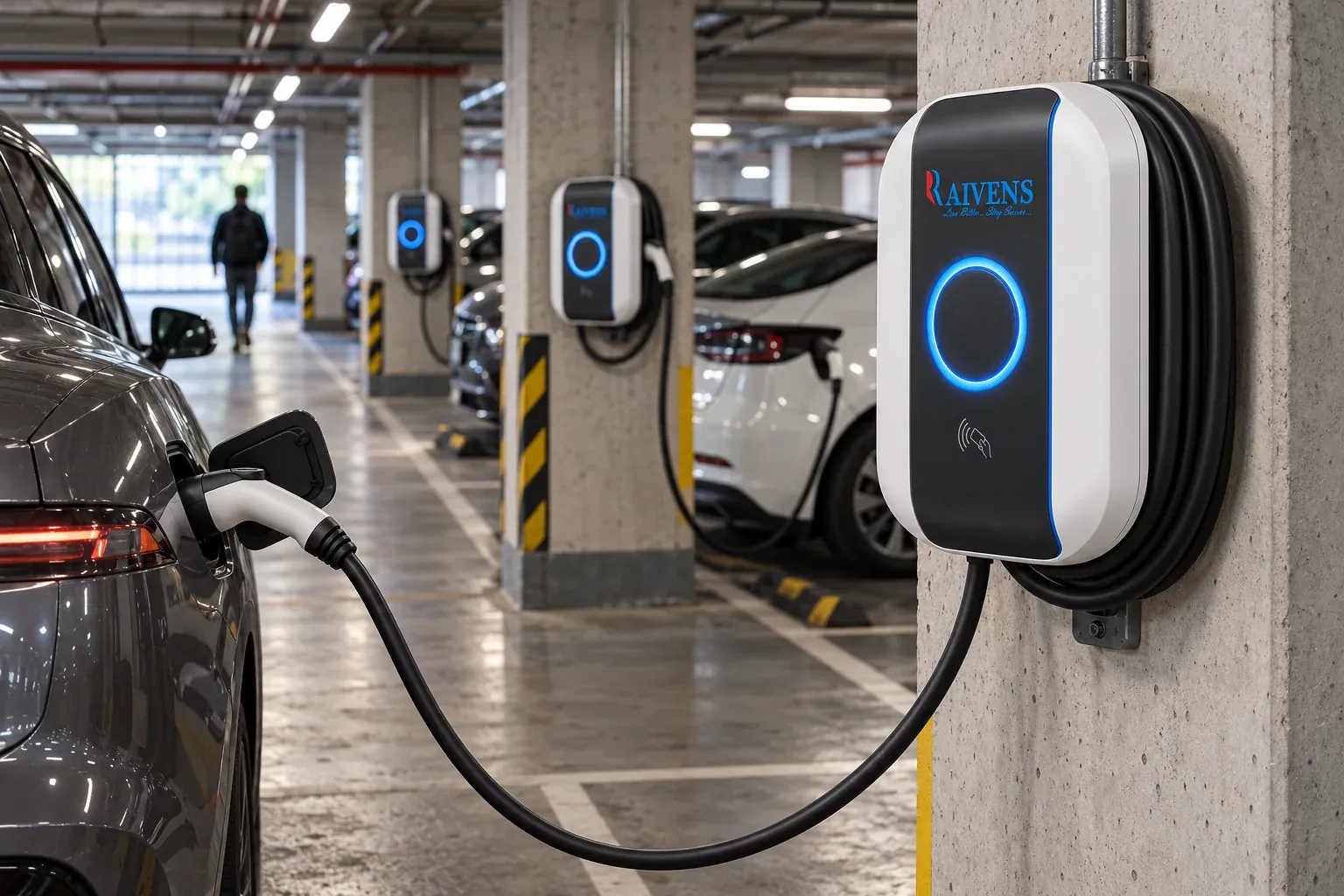
Raivens designs and manufactures both charger types in-house, including the electronics, firmware and cloud software, and supports installation and after-sales service.
- RAIVENS AC EV chargers are wall-mount and pedestal wallboxes from 3.3 to 7.4 kW single-phase, with 11 and 22 kW three-phase options, a Type 2 socket or tethered cable, RFID and app control, Wi-Fi, 4G or Ethernet connectivity, and scheduling with load management.
- DC fast EV chargers from the evTor Powerpulse family come in 30, 60 and 120 kW models, with dual connectors (CCS2 as standard, GB/T and other options), a 7-inch touchscreen, RFID, app and QR authentication, and a remote monitoring and billing backend.
Explore chargers and smart meters together on the EV charging and smart energy solutions page. To plan a site, contact Raivens with your vehicle list, parking pattern and supply details, and our team will help you compare AC and DC options.
Frequently asked questions
Can I install a DC fast charger at home?
It is possible but rarely practical. DC fast chargers start at about 30 kW and usually need a three-phase supply sized for them, which most homes do not have. A car parked overnight gets a full charge from a 7.4 kW AC wallbox, or from 11 kW where three-phase supply and the car allow it. Raivens recommends AC for homes and DC for fleets, highways and other quick-turnaround sites.
Will a 22 kW AC charger charge every car at 22 kW?
No. With AC charging, the car's onboard charger sets the limit. Many cars accept 7.4 or 11 kW on AC, and some accept only single-phase power, so they charge at 7.4 kW or less even on a 22 kW unit. A 22 kW charger still makes sense for mixed fleets and visitor bays, where some cars can use the full rating and load management shares the available capacity.
Does DC fast charging harm the battery?
Modern EVs protect their batteries by limiting DC power when the battery is cold, hot or nearly full. Frequent high-power charging can add some long-term wear, especially in hot climates, so many fleets charge on AC overnight and use DC when time is short. Follow each vehicle manufacturer's guidance, and use charger scheduling to keep routine charging on AC where possible.
How many chargers does an office or fleet depot need?
Start with the vehicles, not the chargers. Count how many park at the same time, how long they stay and how far they drive each day. Long dwell times allow fewer, shared AC points with load management, while tight turnarounds call for DC. Raivens can review your vehicle mix, parking pattern and supply capacity and suggest a charger plan you can expand later.